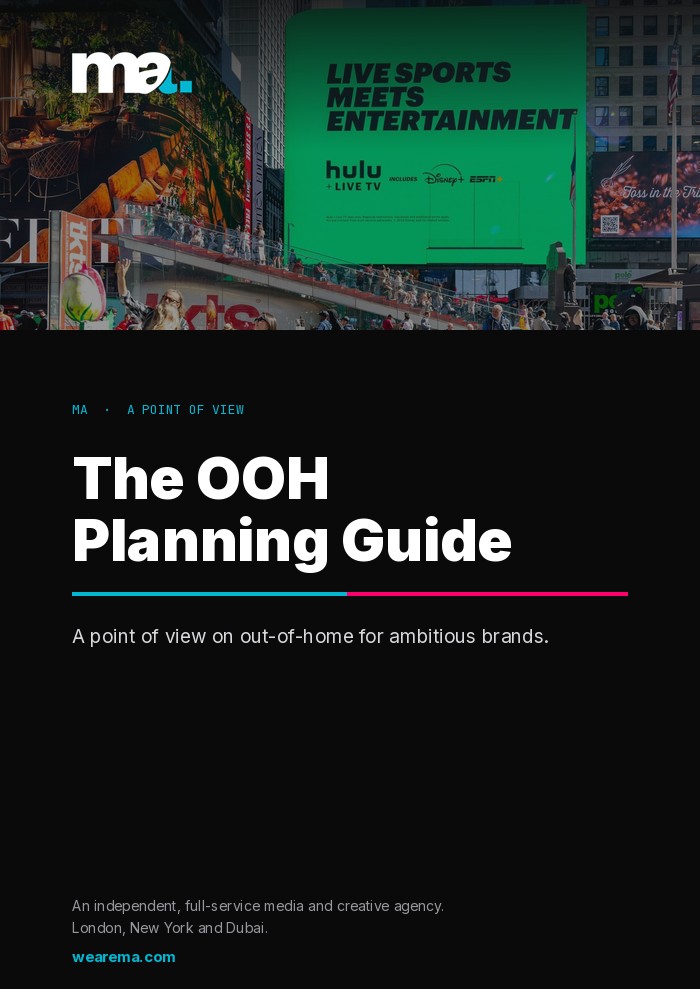
A point of view on out-of-home for ambitious brands. Not a catalogue of formats, and not a sales brochure: the thinking we use every day at ma, written for the marketers who have to make the call.
Free to read
Buy memory, not media.
Every year it becomes harder, and more expensive, to earn people's attention. The brands getting the most from out-of-home are not always the ones spending the most. They are the ones planning it differently.
This is how we think about it: a short, practical read you are welcome to keep and share, with no strings attached.
Attention has become the most contested resource in marketing, and the most expensive.
Every year there is more content, more channels and more noise, and every year it costs a little more to be seen and a little less time to be remembered. Digital promised precision and, for a while, delivered it. But precision at scale has a price, and that price keeps rising. The feed is crowded, the auction is hot, and the half-life of a digital impression is measured in seconds.
This is the paradox worth sitting with: in the most digital era in history, the physical world has quietly become one of the few places a brand can still be unmissable.
Out-of-home is not a nostalgia play. It is a response to where attention actually is. It reaches people when they are not being asked to click, cannot skip, and have somewhere to look. Used well, it does something the feed cannot. It makes a brand feel large, established and worth trusting, and it makes every other channel work harder.
It is also how we think. At ma we plan to a single idea: buy memory, not media. The job is not to rack up impressions that vanish by the next junction. It is to leave something behind in the mind of the person who saw it, and everything that follows in this guide returns to that one belief.
This guide is our point of view on how to plan it well. It is not a directory of formats. It is the thinking we use every day at ma, written for the marketing and brand leaders who have to make the call. If one idea in here changes how you brief your next campaign, it has done its job.
01
Why physical still wins in a digital world
Start with an uncomfortable truth about digital: most of it is not remembered.
A large share of online advertising is served to be scrolled past. It is measurable, which is not the same as being memorable, and the industry has spent a decade confusing the two. Out-of-home sits at the other end of that spectrum. It cannot be blocked, skipped or muted, and it reaches people in a public, shared context that lends a brand a quality performance media struggles to buy: legitimacy.
The reach is not trivial either. Out-of-home reaches 98 per cent of the UK population every week, which makes it one of the few genuine mass-reach channels left standing.
But the number that should change how you think is this one. Nielsen's research puts out-of-home at 26 per cent of the online search activity prompted by offline media, while accounting for roughly 7 per cent of the advertising spend. Read that again. It punches nearly four times above its weight at driving the digital response everyone is optimising for.
Out-of-home does not compete with your performance media. It makes your performance media work harder.
The brands that win with physical media are not the ones with the largest budgets. They are the ones who understand that being seen in the real world changes how a brand is received everywhere else.
02
What out-of-home actually does for a business
Fame is the word the industry reaches for, and it is not wrong, but it is too soft to brief against. Here is what a strong physical presence actually does in commercial terms.
It changes perception before a single word is read. Scale signals success. A brand that can command a landmark site is, in the mind of the person walking past, a brand that is winning. Perception moves before the message even lands.
It builds trust. Public, physical presence is a costly signal, and audiences read it as such. A brand that shows up in the real world feels more permanent, more accountable and safer to choose. In categories built on confidence, from finance to healthcare to premium retail, that is not a soft benefit. It is the sale.
It makes digital perform harder. This is the effect most planners underrate. A person who has seen your brand at scale searches for it by name, clicks with more intent, and converts at a lower cost. Out-of-home does not just run alongside your funnel. It lowers the price of every stage of it. We have watched a single landmark takeover lift branded search enough that the performance team's cost per acquisition fell for the length of the burst. The billboard, in effect, subsidised the paid search.
It influences purchase in ways attribution cannot see. The last click gets the credit. The billboard that made the brand familiar three weeks earlier does not. That is a measurement problem, not a value problem.
It works inside the business, not just outside it. A brand that feels famous is easier to sell for your sales team, easier to hire for, and easier to defend in a boardroom. Physical presence gives a company the confidence of a market leader, and confidence is contagious across customers, staff and investors alike.
03
Why physical media creates memory
This is the section most guides skip, and it is the most important one.
Advertising only works if it is remembered, and memory is not built by exposure alone. It is built by attention, emotion and context, and the physical world is unusually good at supplying all three.
People remember places. Human memory is spatial before it is anything else. We remember where we were when something happened. A brand tied to a real place, a station, a street, a skyline, borrows that spatial memory in a way a banner ad never can.
People remember scale. Size is not vanity. A large-format site is processed as significant precisely because it is large, and significance is what the brain files and keeps. Impressiveness is itself a message.
People remember experiences, not impressions. A digital impression is a moment that disappears. A hand-painted mural, a station takeover, a screen that stops you on the way to your train, these are small experiences, and experiences are what the mind stores.
Physical media carries permanence. A building has been there, and will be there tomorrow. That continuity transfers to the brand on it. Permanence is a feeling, and it is one performance media cannot manufacture.
Landmarks create emotional associations. Put a brand somewhere iconic and it inherits the feeling of the place. The emotion attached to a landmark becomes, by association, emotion attached to the brand.
The research supports the instinct. Attention is the gateway to memory, and high-attention environments drive far larger shifts in brand choice than low-attention ones. The physical world, where people are present rather than half-scrolling, is one of the last high-attention environments left.
Buildings become memories. Impressions disappear.
04
Choosing the environment: answer a strategic question
Do not start with formats. Start with the question your campaign is trying to answer. Each out-of-home environment is really the answer to a different one.
Want to dominate a city, fast? Roadside and large-format. Broad, simple, unavoidable. This is how a brand goes from unknown to everywhere in a fortnight.
Want to reach decision-makers who screen out most advertising? Airports. A rare environment where a senior, affluent, hard-to-reach audience is captive, unhurried and receptive, and where a brand borrows the calm and prestige of the space.
Want repeated exposure to the same high-value audience? Transport and the Underground. People wait, and waiting is dwell time. Frequency compounds against a captive commuter audience day after day.
Want people to stop, and to photograph it? Landmark sites, spectaculars and hand-painted murals. Scarcity and craft are the point. The photograph travels far beyond the people who pass it.
Want to be part of a cultural moment? Cinema and premium indoor large-format. Engaged audiences, receptive frame of mind, often before a shared social occasion.
Want to nudge a decision close to the point of purchase? Retail and point-of-sale, working alongside a broader brand presence rather than in place of one.
Most strong campaigns use two environments on purpose, one for fame and one for frequency. Very few need more than three.
05
The Five Rules of Effective OOH Creative
The environment can be flawless and the campaign can still fail if the creative fights the format. Out-of-home rewards discipline. We brief against five rules.
One message. If it says two things, it says nothing. Decide the single thought and cut the rest.
One glance. Assume three seconds, in motion, from a distance. If it cannot be understood in a glance, it will not be understood at all.
One brand. The brand should be obvious immediately, not discovered at the end. Fame only compounds when people know whose it is.
One emotion. Information is forgotten. Feeling is remembered. Aim to make someone feel something, not just know something.
One memorable idea. The best sites leave a single image in the mind that the audience carries away. If nothing stays, nothing worked.
06
Not all inventory is equal
Here is something the open market will not tell you: the best out-of-home is rarely the out-of-home you can simply buy off a list.
The most valuable positions, the landmark sites, the true spectaculars, the takeovers that define a moment, are finite. They move through relationships, not rate cards, and they go to whoever is ready and trusted when the window opens. This is where an independent agency with real media-owner relationships earns its fee several times over.
Understanding the layers of availability changes how you plan:
Premium and landmark inventory is scarce by definition. Its value is precisely that not everyone can have it.
First-refusal and negotiated availability exists for agencies with standing relationships, long before it reaches an open list, if it reaches one at all.
Cancellations and late availability on premium sites are one of the quiet advantages of the market. A brand ready to move quickly can secure a position, at a better rate, that was never openly for sale. Flexibility is a buying strategy, not a compromise.
Rate card is a starting point, not a price. A well-negotiated campaign rarely pays published rates. Independence matters here. Advice with no obligation to spend where it suits a parent company is advice genuinely on your side.
In practice. A recent brief called for a landmark position that was on no public list. Because the opening came through a media-owner relationship rather than a rate card, the brand secured a defining site weeks before it would have surfaced anywhere, at a price the open market never saw. That is what access actually looks like.
07
What experience actually teaches
Some things are only learned by planning hundreds of campaigns. A few of them are worth more than any format guide.
Buy the audience, not the billboard. The site is a means of delivering an audience. Fall in love with the audience, and let the data choose the sites. Planners who do it the other way round overpay for the familiar.
Famous sites are not always the best investment. The most photographed position is sometimes the least efficient one, priced on prestige rather than performance. Sometimes the answer is the landmark. Often it is the cluster of sites nobody talks about that quietly delivers the audience at half the cost.
Concentration beats dilution. A budget spread thinly across too many environments makes noise, not impact. The same budget concentrated for a fortnight makes a brand feel unavoidable. In out-of-home, weight in one place beats presence in many.
Flexibility improves campaigns. The best buys are frequently the ones you were ready to make when an opportunity appeared, not the ones locked into a rigid plan months earlier. A partner watching the market on your behalf is worth more than a perfect plan set in stone.
Plan the follow-through, not just the poster. The person who sees the site should meet the brand again online. A physical campaign with no digital echo wastes half its value.
In practice. Handed a national budget too small to be felt everywhere, we have concentrated the entire weight into two cities for a fortnight. The brand felt unavoidable where it mattered, branded search rose sharply in those regions, and the same money spread evenly across the country would simply have disappeared.
08
Measuring what matters
Out-of-home can be measured. It simply should not be measured like a click.
Audience delivery is the baseline: independently verified estimates of who was reached, and how often.
Brand lift is the proof: pre-and-post research on awareness, consideration and perception in exposed areas versus control.
The digital echo is often the clearest signal: branded search, direct traffic and improved digital performance during and after the burst. When these move, the campaign is working.
Business outcomes are the point: footfall, enquiries and sales in exposed regions against control regions.
The ma Planning Principles
Six principles, refined across hundreds of campaigns. If you take nothing else from this guide, take these.
One. Audience before asset. Buy the people you need to reach, and let that choose the sites. Never the reverse.
Two. Concentrate, do not dilute. Weight in one place beats presence in many. Make the audience feel you are everywhere by owning somewhere.
Three. Design for the environment. The idea must be built for the format and the moment, not adapted from a screen and hoped for.
Four. Think beyond the poster. Plan the physical moment and the digital follow-through as one campaign, so the impression compounds.
Five. Negotiate everything. Rate card is an opening position. Access, timing and flexibility are where value is won or lost.
Six. Buy memory, not media. The goal is not impressions. It is to leave something behind in the mind of the person who saw it. Everything else is a means to that end.
Sources: weekly reach, Route / Outsmart, UK. Online activation and search-versus-spend figures, Nielsen OOH Online Activation Survey, United States. Fame and share-of-voice effects, IPA and WARC. Attention and memory, Ipsos.
Planning something unmissable?
If you are weighing up an out-of-home campaign, we are always happy to review a brief and share our thoughts: whether OOH is the right channel, where we would invest, what we would avoid, and whether the creative is likely to work. No strings, and no pitch. Just a straight opinion.